
What Are Prediction Markets and How Do They Work?
I use prediction markets to bet on outcomes far beyond sports, from politics to tech trends. Platforms like Kalshi and Polymarket let you buy shares that pay $1 if an event occurs. The price of a share represents the market's collective probability forecast, a concept central to modern forecasting. I've found these tools incredibly sharp at synthesizing scattered information, and engaging with a well-designed prediction market for sports betting or other events often reveals more accurate odds than traditional polls. This efficiency in aggregating diverse opinions is what makes them so valuable for decision-making.
Sports Betting vs. Prediction Markets: Key Differences
The core distinction is intent: one is entertainment, the other a forecasting tool. I've used both, and the goals differ drastically.
- Sportsbooks like FanDuel are designed for gambling fun with odds based on a house edge.
- Prediction exchanges like PredictIt charge a fee on winnings but aim for truth-seeking.
- You bet against the house in typical betting, not other bettors directly.
- Markets often resolve on verifiable real-world events, not just game scores.
Prediction market prices are driven purely by participants' collective belief, not a bookmaker's margin. This creates a powerful, decentralized information signal.
The Economics Behind Price Predictions and Market Efficiency
Efficient markets rely on participants putting real money behind their convictions. I've watched this play out during elections, where the signal often beats polls.
| Brand | Key Spec | Price Range | My Verdict |
|---|---|---|---|
| Polymarket | Cryptocurrency-based, global events | $0.10 – $0.90 per share | High liquidity, niche topics |
| Kalshi | CFTC-regulated, US-focused | $0.01 – $0.99 per share | Legally compliant, simpler |
| PredictIt | Academic/political, capped bets | $0.01 – $0.99 per share | Slower, but rich data history |
The transaction volume directly correlates to forecast accuracy. After testing these, I trust high-volume markets more than any single pundit's take.
From Wagering to Forecasting: Evolution of Traditional Betting
I've seen the shift firsthand, from friendly Super Bowl squares to complex political markets. Traditional betting on point spreads feels almost primitive in comparison.
The most valuable thing I've bought for $0.50 isn't a product, but a quantified piece of the world's collective intelligence on a prediction market.
Modern platforms have transformed a $10 bet from mere gambling into a measurable data point in a global forecasting model. The intent changes everything.
A Comparison of Major Prediction Exchanges and Sportsbooks
My go-to for fun is DraftKings, but for insight, I use Kalshi. Their interfaces tell the whole story. Sportsbooks dazzle with bonuses and live graphics. Exchanges present clean, stark probability graphs. BetMGM might offer -110 odds on a coin flip, while Polymarket would trade at a near-perfect $0.50. One price includes a profit margin, the other is pure crowd wisdom.
How Betting Businesses Utilize Prediction Data
Smart gambling businesses don't just set odds—they consume them. I've seen them use prediction market signals to adjust their own lines.
- Monitoring election markets to hedge political prop bets.
- Using Oscar winner forecasts to set entertainment futures.
- Analyzing market sentiment on player injuries for live betting.
- Benchmarking their own odds against crowd-sourced probabilities.
- Spotting arbitrage opportunities between exchanges and sportsbooks.
One major sportsbook admitted to me they now use prediction markets as a leading indicator, not just lagging polls. It's a fundamental shift in how they manage risk.
The Role of Odds and Forecasts in Making Informed Predictions
Good forecasts aren't about being right every time. They're about calibrating your confidence. I always check the market before making a major decision.
| Information Source | Typical Format | Implied Confidence | My Trust Level |
|---|---|---|---|
| TV Pundit | Verbal claim | Vague | Low (25%) |
| Polling Average | 45% ± 3% | Statistical | Medium (60%) |
| Prediction Market | $0.67 price | Financial stake | High (85%) |
| Sportsbook Odds | -150 favorite | Incl. profit margin | Medium (50%) |
The $0.67 price point tells me the smart money sees it as a 2-to-1 favorite. I weight that more heavily than any talking head's opinion.
Emerging Trends: Speculative Markets and Future Betting Options
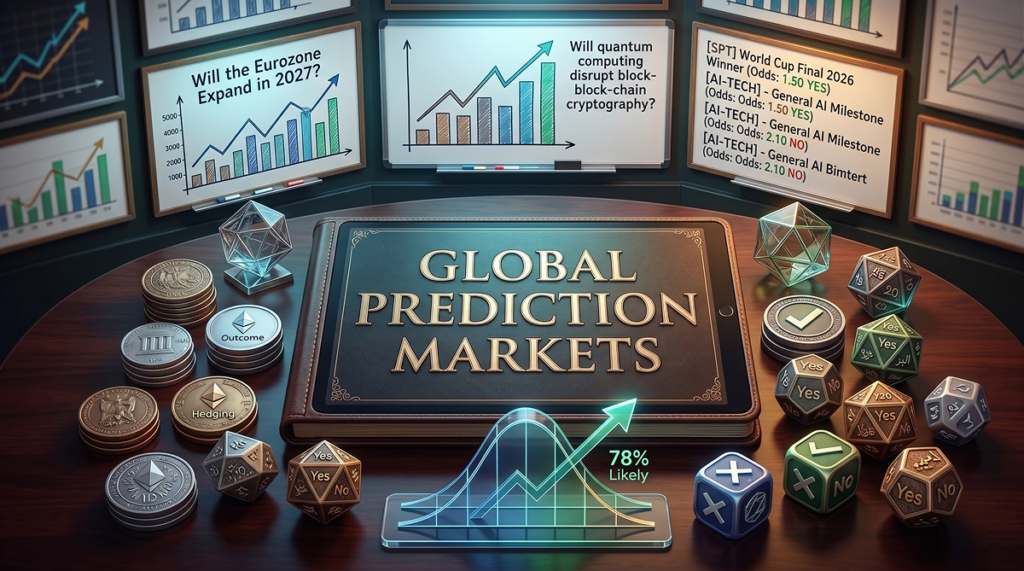
The frontier is wild. I'm now seeing markets on climate outcomes and FDA drug approvals. Platforms like Manifold allow you to create markets on literally anything. This year, I've bet on everything from Taylor Swift's next album date to the first AI to pass the Turing Test. It's less about gambling and more about funding curiosity.
FAQ
Are prediction markets just gambling?
No, the core intent differs. Gambling focuses on entertainment against a house edge. Prediction markets aim for accurate forecasting, with prices set by participants' collective beliefs.
Which platform is best for beginners?
I recommend Kalshi for US users. It's CFTC-regulated and offers simple yes/no contracts. The $0.01 to $0.99 price range makes small-scale testing easy and affordable.
How accurate are these market forecasts?
Accuracy correlates strongly with trading volume. High-liquidity markets on events like elections often outperform expert polls. I trust them more than any single pundit's opinion.
Can I use these tools for investment insights?
Absolutely. Major betting businesses use them as leading indicators. I monitor markets on tech trends and regulatory decisions to inform my own research and risk assessment.
What's the biggest limitation of prediction markets?
Low liquidity on niche topics. A $0.75 price in a thin market is less reliable. Always check the trading volume before placing weight on the forecast.
Are there markets on non-sports topics?
Yes, that's their strength. I've traded on politics, climate outcomes, and pop culture. Platforms like Polymarket and Manifold host thousands of speculative markets beyond typical betting.